



The Woodhull Freedom Foundation is the lead plaintiff in the lawsuit challenging FOSTA. Its legal challenge started in the spring of 2018, when the organization began to struggle with its online promotion of events involving sex workers at its annual Sexual Freedom Summit.
The law broadly prohibits the promotion or facilitation of consensual sex work using the internet. Facilitation generally means “to make easier,” so Woodhull questioned how it could promote its 2018 Summit events involving sex worker advocacy and harm reduction, or publish the biographies of its sex worker presenters, without running afoul of the new law.
As discussed during the panel, sex trafficking is not caused by pornography, despite persistent efforts to conflate the concepts.
Was it promoting sex work, or making sex work easier? FOSTA’s failure to define the word“promote” or “facilitate” or even “prostitution” made it difficult for any reasonable person to know where the line would be drawn. That struggle resulted in the lawsuit challenging FOSTA for violating the First and Fifth Amendments to the Constitution.
Since FOSTA was adopted, countless websites have gone dark and sexual content has been purged from large online platform providers. Sex workers now face increased danger, and law enforcement has lost its access to online information to prosecute traffickers. Woodhull, and the other Plaintiffs, have kept fighting. The appeal of the district court’s decision dismissing the case, based on lack of standing, will now be heard by the United States Circuit Court, D.C. Circuit, on Sept. 20.
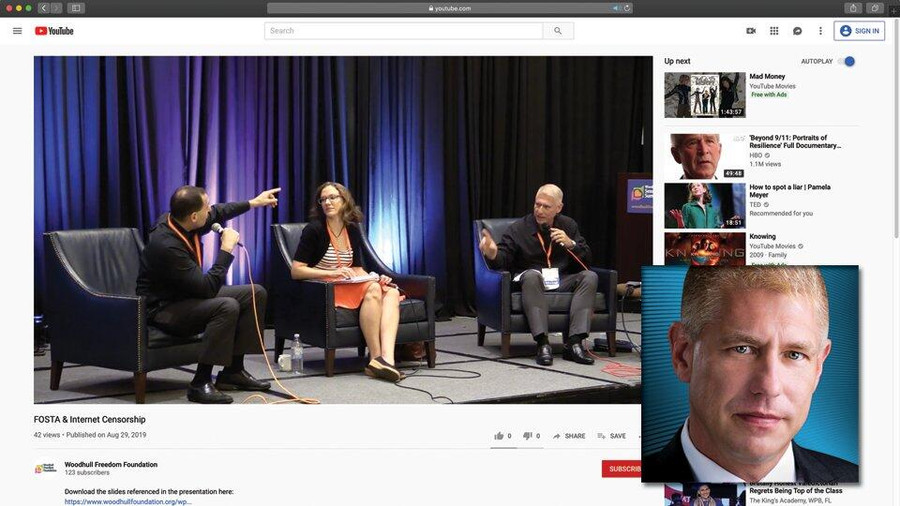
Woodhull has continued to conduct its Summit, and this year partnered with the Sex Workers Outreach Project (SWOP) in its efforts to support the sex worker community as Woodhull pursues its mission of affirming sexual freedom as a human right. The 2019 Summit included a panel specifically addressing the impacts of FOSTA, both on sex workers specifically, and internet freedom generally. The panel included Emma Llansó, Director of the Center for Democracy and Technology’s (CDT) Free Expression Project, Ronald London, attorney with Davis Wright Tremaine, and yours truly, of Walters Law Group.
The panelists are all involved in the fight against FOSTA in some form. CDT has been a staunch advocate for online freedom and helped sound the alarm bells when the FOSTA and SESTA bills were working their way through Congress. London, along with his partner Bob Corn-Revere, are counsel of record in the Woodhull v. United States, along with Walters and attorneys with the Electronic Frontier Foundation (EFF).
The FOSTA panel lasted over 90 minutes and provided a full update on how FOSTA has harmed sex workers, hampered law enforcement and stifled online innovation. Llansó described how the FOSTA “monster” came to be, and how it dramatically changed existing federal law that provided immunity for interactive computer services which host third party content. Myself and London discussed the status of the lawsuit, and the potential outcomes. Ultimately, the case may be headed for a U.S. Supreme Court appeal.
The panel delved into the numerous myths that fueled the adoption of FOSTA, such as:
- Criminalization of prostitution works
- All prostitution is sexual slavery
- Sex trafficking is fueled by a proliferation of pornography
- Decriminalization is harmful
Each of these myths have been debunked by facts, studies or experiences in other countries that have decriminalized prostitution. The more criminalized sex work is, the more violence and exploitation sex workers face, by police, customers and others. Consensual sex work is very different activity from sex trafficking, and cannot be effectively treated by one-size-fits-all laws like FOSTA.
As discussed during the panel, sex trafficking is not caused by pornography, despite persistent efforts to conflate the concepts. A similar strategy has been used by censors to link illegal child pornography with constitutionally-protected adult media. Jurisdictions that have decriminalized prostitution have seen fewer negative health and safety consequences for sex workers.
The damage already caused by FOSTA highlights the importance of Woodhull’s lawsuit. London pointed out how civil claimants are already arguing that FOSTA allows website operators to be sued for any state law violations that are consistent with FOSTA’s prohibitions. This greatly expands the potential legal exposure facing internet platforms, and results in more censorship of erotic speech. Fortunately, Woodhull has many allies in its fight. Additional plaintiffs in the suit include The Internet Archive; Alex Andrews/SWOP Orlando, Human Rights Watch and Eric Koszyk (a licensed massage therapist who lost his opportunity to advertise on Craigslist.org due to FOSTA).
Numerous other groups have filed briefs in support of the challenge at the appellate level, including CDT, Reddit, the Free Speech Coalition, Decriminalize Sex Work, the Institute for Free Speech and the National Coalition for Sexual Freedom. London pointed out that some groups also filed brief in support of the government, such as a coalition of individual states. However, their brief actually supported the plaintiffs’ arguments since they illuminated the credible threat of prosecution by states anxiously awaiting the opportunity to broadly enforce FOSTA against website operators.
The panelists fielded many questions from the audience on how they should operate in a post-FOSTA world, and the potential results of the litigation. Some wanted to know more details about the lawsuit or potential additional challenges to FOSTA. Some were curious about new threats to banking relationships or mandatory age verification.
The panelists warned that other bills, modeled after FOSTA, are currently pending, which would take away even more protection for online service providers and inhibit speech in other areas. Overall, the well-attended panel offered a realistic assessment of how FOSTA changed the internet for anyone operating in the adult or sex worker industries and provided a beacon of hope for change through the courts.
The full session can be viewed on the YouTube channel of Woodhull Freedom Foundation.
Lawrence G. Walters heads up Walters Law Group, which can be contacted at FirstAmendment.com. The firm represents clients involved in all aspects of the adult industry. Nothing in this article is intended as legal advice.



