



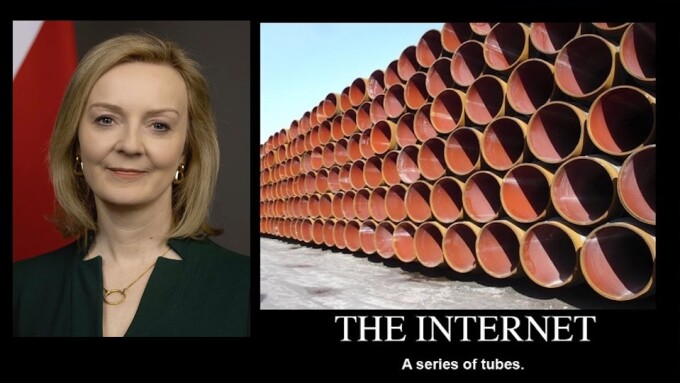
LONDON — U.K. Foreign Secretary Liz Truss, the current leading Conservative Party candidate to succeed resigning Prime Minister Boris Johnson, recently expressed support for the controversial Online Safety Bill with a mystifying statement about an imaginary “two-track internet,” described by observers as “one for teens and one that protects adult free speech.”
Current versions of the bill implicitly create a legal category of “pornography websites,” which would then become subject to record-keeping mandates.
Such mandates, which remain on the agenda for U.K. anti-porn conservatives and their allies, could potentially also force open platforms such as Twitter or Reddit, which tolerate adult content, to reevaluate their content policies in order to avoid being categorized as “pornography websites” and thereby face the task of keeping records of the age and identity of anyone appearing in any piece of sexual content.
”Truss asked about online harms bill, suggests two-track internet — one for teens and one that protects adult free speech,” tweeted reporter Latika M. Bourke. “She says she's worried about what her teen daughters see, but adults should have free speech. HOW would you set up a different internet re age of user???”
Truss’ views are being scrutinized by Conservative Party electors and members of the press, during the Tory-insider process that will culminate in the selection of Johnson’s successor.
Truss currently has a 34-point lead over former finance minister Rishi Sunak, according to a Reuters report. The new Prime Minister will be announced Sept. 5.
Truss 'Certainly' Will Fast-Track the Online Safety Bill
Culture Secretary Nadine Dorries, a key Truss ally and one of the Online Safety Bill’s main promoters, told The Times that Truss would “certainly” continue with the Online Safety Bill if elected Prime Minister, and that she will “pick up the bill where it left off before parliament finished for the summer recess.”
As XBIZ reported, last month the Online Safety Bill was removed from the House of Commons schedule, reportedly to be revisited “in the autumn.”
This action was taken only hours after anti-porn activist and Labour MP Dame Diana Johnson, chair of the Home Affairs Committee, motioned to insert amendments which, in her words, “would place a legal duty on online platforms hosting pornographic content to combat and remove illegal content through the specific and targeted measure of verifying the age and consent of every individual featured in pornographic content on their sites.”
Her amendments were defeated by a vote of 285-220.
Parliamentary newsletter Politics Home reported at the time that the Online Safety Bill — which has been sharply criticized by privacy and digital rights advocates, and promoted by supporters using overt anti-porn propaganda — was “removed from the government's agenda to make space for a motion of ‘no confidence’ in the government due to be put to the House” the following week.
This weekend, Dorries also accused the Labour Party of “putting thousands of children and vulnerable youngsters in danger by calling a ‘sinister’ and ‘nonsensical’ confidence vote in the prime minister this month,” The Times reported.
Amplifying the current moral panic campaign to push forward this controversial law calling for state censorship of internet content, The Times cited a major British charity's claim that “more than 3,500 children a month would be abused online while the bill is delayed.”
Concerns About Free Speech in the U.K.
The Spectator’s David Davis published an opinion piece over the weekend questioning whether Dorries herself understands the proposed legislation.
“Numerous civil liberties organizations have campaigned against elements of the Bill,” Davis noted, highlighting PM candidate Truss’ renewed commitment to enacting it. “And yet Dorries argues that the Bill will make free speech more secure, because somehow, she sees something they do not.”
“The Secretary of State does not seem to understand is that the real danger lies with the subtle pressures on free speech that the Bill will impose,” Davis added.
The Online Safety Bill, he explained, “imposes an onerous ‘duty of care’ on social media providers and obliges them to produce and enforce a policy to deal with ‘legal but harmful’ content. Dorries’s department has wrapped it up in arguments about ‘transparency’ but the pressures will still apply to the platform giants. Inevitably, these companies will err on the side of censorship, for fear of being punished for not censoring enough.”
Many platforms, Davis concluded, are “already predisposed towards policing controversial ideas, as anyone who has spent any time online over the past couple of years will know. Now, the situation looks set to get worse, as they are made to enforce this censorship more rigorously than ever.”
Truss' Imaginary 'Splinternet'
Policy and technology blog site Techdirt this week highlighted a series of posts by open internet activist Heather Burns, “exploring the unfixable problems of the Online Safety Bill.”
Burns, Techdirt reported, highlights “what a total disaster the bill is, and how there are no fixes that can be made that can save it. As she notes, this very much creates a ‘splinternet’ in which the U.K. internet is not just conceptually different than the rest of the worlds’ internet, but technically different as well, as it requires three effectively impossible features,” including a mandatory age verification layer, a surveillance layer that will monitor all content and “an effective ban on end-to-end encryption.”
Truss’ comments “more-or-less confirm that this is how the Online Safety Bill will work,” Techdirt explained, adding that the prospective Prime Minister now wants to create “an entirely different internet, one that is fundamentally incompatible with the actual internet.”



