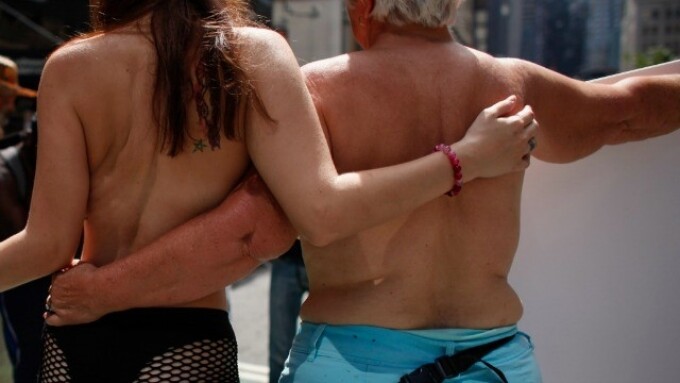
SAN FRANCISCO — The 9th U.S. Circuit Court of Appeals today upheld San Francisco’s restriction on nudity in public places, ruling the city’s goals of “preventing distraction and offense to citizens not expecting to be confronted with private parts of other persons’ anatomy” justifies restricting nudists' free-speech rights.
With the decision, a 9th Circuit panel dismissed claims made by plaintiffs Oxane “Gypsy” Taub and George Davis arising out of the city’s enforcement of a public nudity ordinance. In their suit, the “body freedom” advocates alleged their First Amendment rights were violated.
One of Taub and Davis’ attorneys, however, said that the fight over nudity rights in San Francisco likely is not over.
“We are meeting with our clients to determine the next step, but I can certainly assure you they are not going away and they will continue to fight the good fight,” industry attorney D. Gill Sperlein told XBIZ.
Sperlein said that he, along with co-counsel Lawrence Walters, were “deeply disappointed” with the result at the 9th Circuit.
“The court side-stepped certain issues,” Sperlein said. “More troubling, the court stated that we did not provide ‘evidence of a pattern of abuse.’ The problem is that this was an appeal from a dismissal on the pleadings, meaning that there was no opportunity to provide evidence.”
The three-member panel of the 9th Circuit said that it dismissed the case based on an applicable test made in U.S. v. O’Brien — because the San Francisco ordinance is aimed at the conduct itself, rather than at the message conveyed by that conduct.
Even if Taub and Davis’ public nudity at political rallies was entitled to First Amendment protection, they said, the challenged ordinance is a valid, content-neutral regulation.
The court in its ruling said: “First, restricting public nudity falls within San Francisco’s traditional police powers. Second, the ordinance furthers San Francisco’s important and substantial interests in protecting individuals ‘who are unwillingly or unexpectedly exposed’ to public nudity and preventing ‘distractions, obstructions, and crowds that interfere with the safety and free flow of pedestrian and vehicular traffic.’”
“Third, San Francisco’s interest is unrelated to the suppression of free expression, because the ordinance regulates public nudity whether or not it is expressive. Fourth, ‘the incidental restriction on alleged First Amendment freedoms is no greater than is essential to the furtherance of that interest.’
“The ordinance prohibits only exposure of one’s ‘genitals, perineum, or anal region,’ during daily activities in the streets of San Francisco … which is essential to meet the city’s goals of preventing distraction and offense to citizens not expecting to be confronted with such private parts of other persons’ anatomy."
Today’s ruling by the panel was preceded by another lawsuit filed by Taub and Davis over the San Francisco Police Department’s denial of a parade permit for a “nude-in” event. That case ended in a settlement.
SFPD denied the parade permit application on the grounds that the 50 to 100 nude activists expected for the event was not large enough to warrant a parade permit. Nevertheless, the parade took place before San Francisco’s famous Folsom Street Fair after a federal judge issued an emergency opinion the day before the event.
In that case, Sperlein and Walters argued that it would be unconstitutional to allow the SFPD to require a minimum number of people since the permitting ordinance contained no such limitation.
As a result of the settlement in that separate case, the City of San Francisco agreed to pay $15,000 in attorneys’ fees.