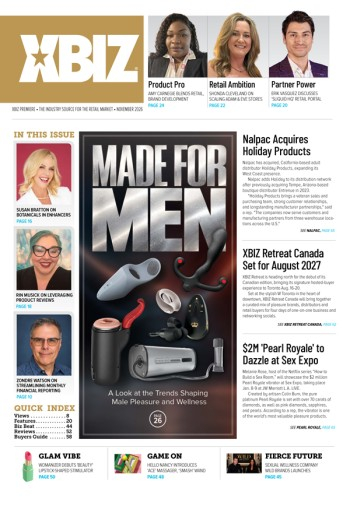
A lot of the pleasure products marketing seems to target predominantly women and while that certainly makes sense I sometimes wonder if a huge swath of customers is being promotionally neglected. I’m referring to the males.
Last September John Millward analyzed a year’s worth of pleasure products sales data from Lovehoney.co.uk — I found the results to be quite interesting. There are of course loads of noteworthy tidbits and I invite any human involved in the selling and/or marketing of pleasure products to pour over the results at their convenience. One finding supports the case for a sort of Fifty Shades Effect. For instance, females in relationships now account for the largest number of restraint purchases when compared with single or attached men and women. Another result showed that single men was the largest demographic to purchase lube — 10 percent more than women in relationships.
Since men spend about 20 percent more on average, it certainly might pay to look at devoting resources to target new male customers and renew your focus on existing male customers and retention.
More broadly however, the survey paints a very clear picture of which (basic) customer segments are buying what, how much they spend, how often they buy, and a lot more. Women certainly buy more vibrators — but this data shows that men buy more anal toys, cock rings, dildos, lube and of course male sex toys. The data also shows the gender split in customers for all purchases to be right down the middle: 50/50. Certainly nobody is saying that these results will mirror yours, there are many variables that account for each store or website’s customer base — but there are some fundamentals that will likely apply most everywhere.
CreditCards.com shared some customer information recently and found that three out of four American adults make impulse buys. Perfect right? A lot of pleasure products sales are just that — impulse, spur of the moment buys. Now add to that, “Men were significantly more likely than women to spend serious money on that unplanned purchase. While just 7 percent of the women said they had spent $500 or more, 21 percent of the men did.” The survey summary continues, “Men also made more impulse purchases of $1,000 or more.” Millward’s analysis corroborates those kind of male vs. women spending results as well, “On average, men spend 19 percent more per order than women.” Nineteen percent more!
There are definitely several takeaways from all the data, but to me the most striking is that men spend more and are as big a customer segment if not a bigger than women when it comes to purchasing pleasure products. Since men spend about 20 percent more on average, it certainly might pay to look at devoting resources to target new male customers and renew your focus on existing male customers and retention.
There are lots of ways to target male customers, one of course might not be to have your shop or website drowned in pink and fuchsia with messaging and language only for the ladies. Keep in mind that men are visual creatures, loud, racy packaging and epic planograms that may seem overwhelming to some, might be perfectly appealing for the wide-eyed male customer.
Very often “male” in pleasure products marketing just means “gay” and that’s not always the case. If you’re looking to attract straight male customers, education of prostate and anal toys is a good place to start. On average males buy 6-12 percent more anal toys than women, but as we know many straight men are confused, ignorant and/or frightened by prostate stimulation. However, at least 30 percent of them are not.
Hey, did you know that men like things big? Straight men — single or attached, bought more big dildos than women. The results in Millward’s sample showed that straight men bought eight-inch dildos are larger, an average of 10-15 percent more often than the women. So if you’re showcasing your large toys, make sure it has a male marketing angle that way you can entice more potential male buyers.
You know what else men like big? Yep, you guessed it: their penis. Create a planogram of penis pumps, penis extensions, strokers and masturbators. Upsell and cross promote with other male buying favorites like lube and cockrings to complete the sale. Create some signage that will appeal to the male customer: “become a bigger and better lover,” “show her the kind of man you are,” “always leave her wanting more.” This kind messaging can also be effective in email blasts, web ads and social media posts. Depending on your store’s space you can create a planogram featuring them all in a “big toys” area for your men — and if you’re on the web, creating these categories and driving your traffic to them with ads shouldn’t be too difficult.
There is a lot of interesting information out there about who pleasure products customers are and how they shop. Now it just boils down to how you use that information to grow your customer base and profits.
Brian Sofer is the digital marketing director for Pipedream Products. Possessing more than 20 years of marketing experience, Brian is a creative, results-oriented marketing professional with extensive experience across his career utilizing digital media.